Unlocking Copper-Gold Potential
Unlocking Copper-Gold Potential: How Machine Learning Is Transforming Mineral Exploration at King-King, Mindanao
8 December 2025
The King-King mining site in Mindanao, Philippines, is fast becoming a key frontier in Southeast Asia's mineral exploration landscape. With a rich endowment of copper and gold, the district is gaining recognition not just for its geologic promise but for how cutting-edge technologies like satellite remote sensing and machine learning are redefining exploration strategies.
Why King-King? A Geological Goldmine
Located in the Eastern Mindanao Volcanic Arc, the King-King district sits along a tectonically dynamic corridor known as the Philippine Mobile Belt rich in porphyry copper-gold (Cu-Au) and epithermal gold systems.
These deposit types are historically associated with significant ore volumes and economic mining potential.
What makes this area particularly attractive to exploration geologists is its:
Porphyry Cu-Au systems: Large, low-to-medium grade deposits formed by hydrothermal fluid circulation near intrusive rock bodies.
Epithermal gold zones: High-grade mineralization closer to the surface.
Structural complexity: Active and ancient faults serve as fluid pathways for metal deposition.
From Satellites to Soil: A Data-Driven Exploration Strategy
Exploration in rugged, vegetated terrains like Mindanao has always been a logistical challenge. But recent advances in remote sensing and AI are shifting the paradigm.
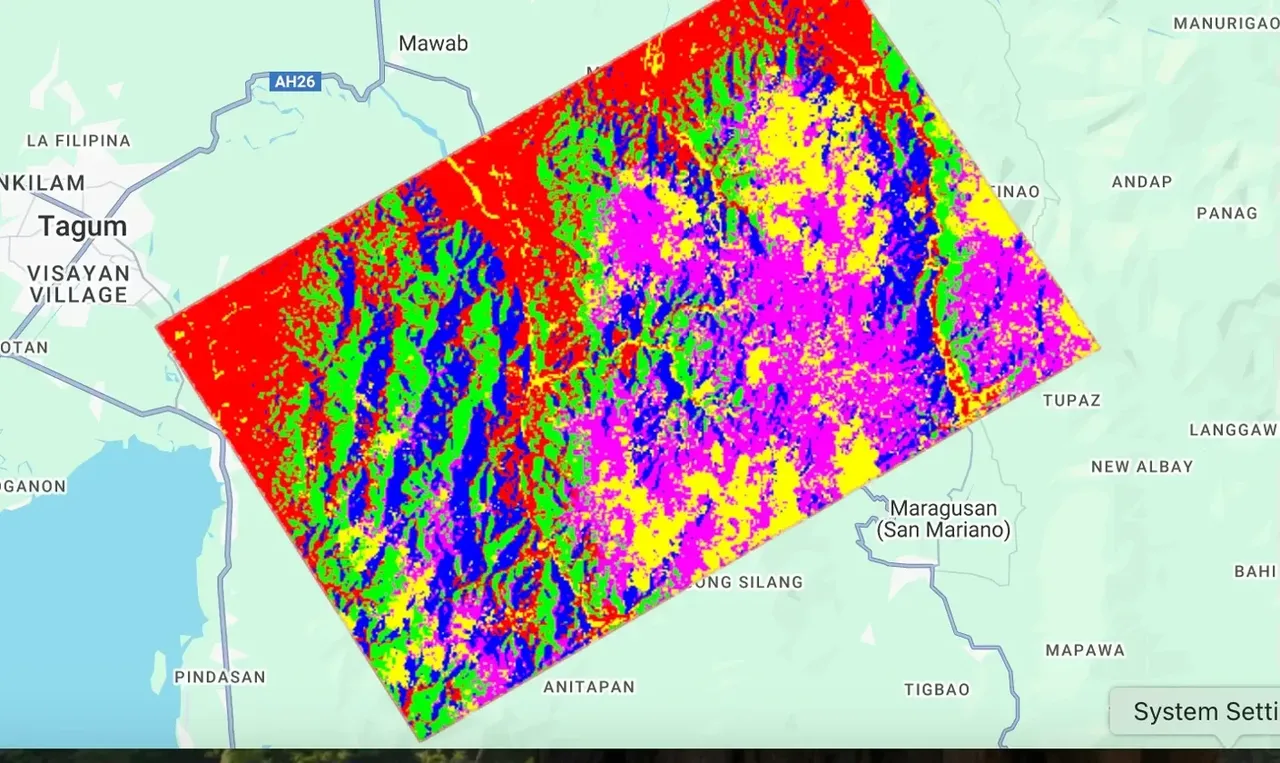
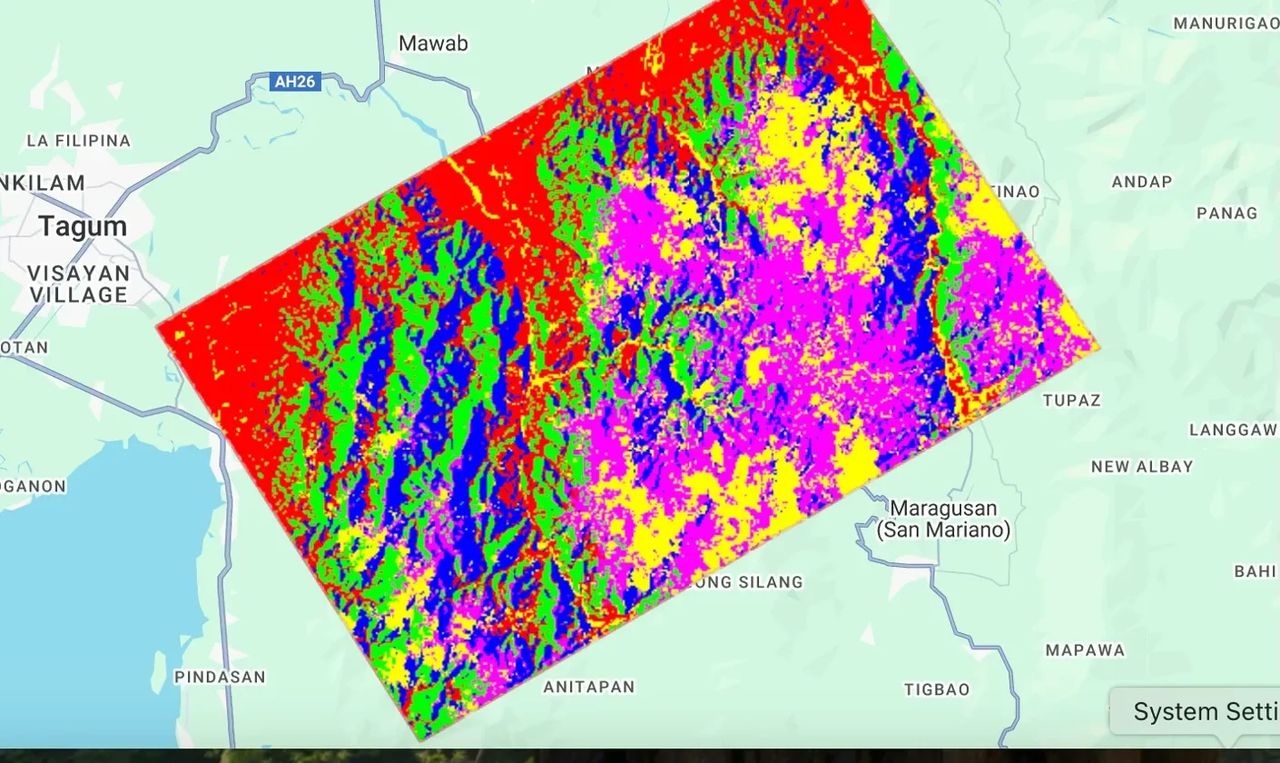
We used Sentinel-2 multispectral satellite imagery, coupled with digital elevation models (DEMs), to classify the terrain using k-means clustering, a machine learning technique that identifies natural groupings based on spectral and topographic patterns.
Key advantages:
Cost-effective: Large-scale reconnaissance without costly fieldwork.
Objective: Avoids interpretation bias common in traditional mapping.
Efficient: Rapidly pinpoints target zones for on-the-ground follow-up.
Mapping Hidden Mineralization Zones
The algorithm categorized the King-King area into several distinct "clusters" or zones:
Yellow Zones: Highly prospective; likely represent phyllic-argillic alteration linked to copper-gold systems.
Green Linear Zones: Suggest fault zones with critical fluid conduits in mineralizing events.
Magenta Zones: Potentially propylitic alteration, marking the distal halo of porphyry systems.
Red Zones: Heavily vegetated or unaltered terrain for lower exploration priority unless structural features suggest otherwise.
Structural Geology: The Hidden X-Factor
One of the most powerful insights emerged when fault line data was overlaid on the cluster map. The spatial correlation was striking:
Yellow and green zones aligned strongly with active faults, fault intersections, and step-over zones—all high-potential structural traps for ore.
This alignment supports the theory that mineralization in King-King is structurally controlled, with faults playing a dual role in fluid transport and magmatic intrusion guidance.
Top Exploration Targets at King-King
Based on spectral and structural data, researchers have ranked exploration zones as follows:
Tier 1: Yellow clusters within 500 meters of active faults or near fault intersections.
Tier 2: Yellow-magenta transitions and isolated green linear zones.
Tier 3: Background zones for regional context and alteration boundary mapping.
What’s Next: Drills, Drones, and Data
To convert remote predictions into mineable reality, a phased exploration roadmap is proposed:
Short-Term: Drone imagery, rock sampling, and geophysical surveys (magnetics, IP).
Medium-Term: Soil/stream geochemical programs and 3D modelling.
Long-Term: Targeted drilling based on fully integrated datasets.
Final Thoughts: A Glimpse Into the Future of Exploration
The King-King project exemplifies how AI-powered remote sensing can dramatically reduce exploration risk while improving targeting accuracy. As datasets grow and algorithms evolve, methods like these will play a central role in discovering the next generation of mineral resources.
This integration of machine learning, structural geology, and geospatial data isn't just a technical innovation—it's a revolution in how we explore the Earth.